

What is sanctions screening and how does it work?
Founder, Lunixi
Sanctions screening is the check that compares the names, identifiers and payments you handle against official sanctions lists, so that you do not onboard, pay or receive money from a person or entity whose assets must be frozen. In practice it runs at three moments: when a customer signs up, before money moves, and again every time a list changes. A match is only the start. Someone, or a well-documented rule, has to decide whether the hit is the listed person or just a similar name, and record why.
This guide explains which lists matter, how matching works when names are spelled ten different ways, how sanctions screening differs from PEP screening, and how a small compliance team can keep false positives under control. It describes practice and official guidance. It is not legal advice: which rules apply to your business depends on your licence and where you operate.
What does sanctions screening actually check?
A sanctions list names people, companies and vessels that governments or the UN have designated, often with identifiers such as passport numbers or digital currency addresses. Most entries carry an asset freeze: their funds and economic resources are frozen, and nobody under that jurisdiction may make funds available to them. Some carry other measures, such as travel bans or trade restrictions. Screening is how a business finds out whether someone it deals with is on such a list.
The Wolfsberg Group, an association of global banks that publishes financial crime guidance, splits screening into two controls (Wolfsberg Group, Guidance on Sanctions Screening, 2019):
- Customer screening checks the reference data you hold: names, dates of birth, nationality, addresses, registration numbers and the beneficial owners of a company.
- Transaction screening checks the payment itself: payer, payee, banks, free-text fields and sometimes the country in the routing.
The same guidance stresses that an alert is only a string of text resembling a list entry; on its own it is not evidence that you are dealing with a sanctioned party.
Ownership matters as well. The US, the EU and the UK all extend freezes to companies that listed persons own, even when the company itself has no list entry, and the EU and the UK also apply a control test. They do not count ownership the same way. OFAC adds together the stakes of several blocked persons and treats an entity owned 50 percent or more in aggregate as blocked; its rule speaks to ownership, not control (OFAC, FAQs on entities owned by blocked persons). The EU Council's best practices also aggregate holdings and add control tests such as the power to appoint most of the board (Council of the EU, EU Best Practices for the effective implementation of restrictive measures, 2024). UK guidance uses a "more than 50 percent" test and generally does not aggregate separate designated persons' holdings (OFSI, UK financial sanctions general guidance). So a screening setup has to check the people behind a company as well as the company name. That means matching the people in your ownership records to list entries, and to the same person across your other merchants; Lunixi's entity resolution suggests such matches and the analyst confirms them.
Which sanctions lists should you screen against?
The answer depends on where you are licensed, the currencies you touch and where your customers are. The table starts with the UN list and the three regimes that most cross-border payment flows touch, then adds national lists.
| List | Published by | Where to get it | Typical reason to screen |
|---|---|---|---|
| UN Security Council Consolidated List | United Nations | scsanctions.un.org | Basis for national freezes worldwide |
| SDN and other OFAC lists | US Treasury (OFAC) | sanctionslist.ofac.treas.gov | US dollar payments, US nexus |
| EU consolidated financial sanctions list | European Commission (DG FISMA) | Financial Sanctions Files | Business in or through the EU |
| UK Sanctions List | FCDO | gov.uk | Business in or through the UK |
| National lists (for example Türkiye's asset-freezing decisions) | National authorities | Official gazettes | Local licence and local customers |
The UK changed its source this year. The OFSI Consolidated List closed on 28 January 2026, and from 9am that day the UK Sanctions List maintained by the FCDO became the only source of UK designations (UK Government, Moving to a single list for UK sanctions designations). If your system still downloads the old OFSI file, it has received no UK designations since that date.
EU sanctions regulations apply directly in every member state once they appear in the Official Journal (EUR-Lex, Article 288 TFEU). The Commission's consolidated list reflects the texts published in the Official Journal, and those texts are what bind you (European Commission, Overview of sanctions and related resources).
The FATF, which sets the global anti-money laundering standard, asks countries to freeze "without delay" the funds of people designated by the UN Security Council for terrorism and proliferation financing (FATF Recommendations 6 and 7). Lists change often, so how quickly you pick up a new designation matters as much as which lists you load.
When should you screen: onboarding, payments or list updates?
All three, because each one closes a different gap.
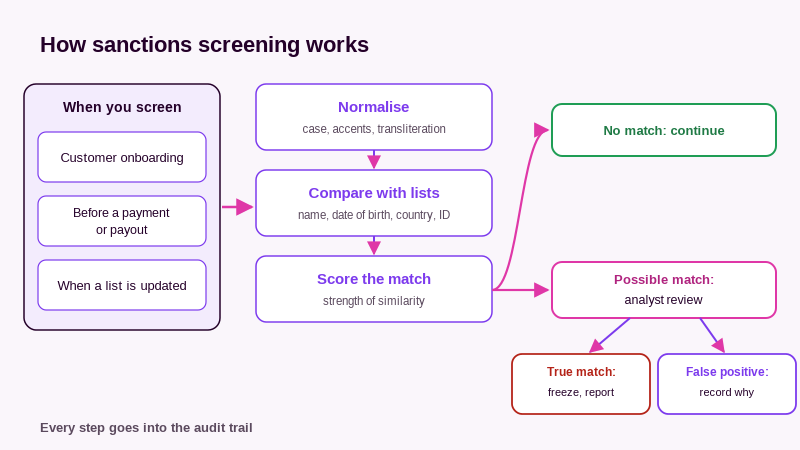
At onboarding you screen the customer and, for a company, its directors and beneficial owners before the account goes live. This is the cheapest moment to stop a problem.
Before money moves you screen the transaction. Wolfsberg describes transaction screening as a check made before the funds move, and real-time screening of cross-border payments as common practice (Wolfsberg Group, 2019). Spain's financial intelligence unit goes further and lists blocking the transaction until its alert is resolved as good practice (SEPBLAC, Buenas prácticas, listas de sanciones, 2015).
When a list changes you re-screen the customers you already have. A customer who was clean in March can be designated in June. The UK aims to add new UN and UK designations to the UK Sanctions List within one working day (OFSI, UK financial sanctions general guidance), and the EU's new Anti-Money Laundering Regulation, which applies from 10 July 2027, says credit and financial institutions must re-screen upon any new designation (EUR-Lex, Regulation (EU) 2024/1624, Article 26).
Say you have 40,000 active merchants and their beneficial owners, about 90,000 names in total. If you re-screen only once a month, a merchant whose owner is newly designated can keep receiving payouts for up to 30 days, because payout screening checks the merchant's name, not its owners. If you re-screen only the delta, meaning the names that were added or changed on the list since the last run, against all 90,000 records each time a list updates, the gap shrinks to however long your update takes. Delta re-screening is also far lighter: ten new list entries compared against 90,000 records is a small job next to the full list compared against 90,000 records every night. Re-screen a customer as well when their own data changes, for example when a new beneficial owner is added.
How does fuzzy name matching work, and where is the threshold?
Names do not travel cleanly. The same person can appear as Mohammed, Muhammad or Mohamed; a Turkish company name loses its "ş" and "ğ" in a bank file; a Cyrillic name gets transliterated two ways. OFAC's compliance framework lists failing to account for alternative spellings as a root cause of real sanctions violations, with examples such as Habana for Havana (OFAC, A Framework for OFAC Compliance Commitments, 2019).
Screening engines handle this in two steps before any decision is made:
- Normalise both sides: lower-case, strip punctuation and accents, fold characters such as "ı" and "i", expand or remove legal suffixes ("Ltd", "A.Ş.", "GmbH"), and transliterate.
- Compare and score with string-distance and phonetic methods. The score expresses how similar the two names are, not how likely it is that the person is sanctioned.
Then you pick a threshold. OFAC's own search tool shows the trade-off clearly: its "Minimum Name Score" slider defaults to 100, which returns exact matches only, and lowering it returns more possible matches. OFAC says it cannot recommend a setting; each user decides based on its own risk assessment (OFAC, Sanctions List Search FAQs). Spain's SEPBLAC calls exact-only matching bad practice and expects similarity thresholds to be set and reviewed periodically (SEPBLAC, 2015).
Suppose you screen 50,000 payments a day and a loose threshold produces an alert rate of 0.4 percent. That is 200 alerts a day. If an analyst clears one in three minutes, you need 10 hours of review every day. Payments do not stop at weekends, so that is 70 hours a week, close to two full-time analysts, before any time goes into escalating a true match. Tightening the threshold to bring the alert rate down to 0.1 percent cuts that to 50 alerts and 2.5 hours. The question is what you miss by tightening; answer it by testing the threshold with known names and spelling variants.
Lunixi's AML and sanctions screening recognises Turkish characters, spelling variants and transliterated names, and grades hits into exact, probable and possible bands that can be tuned.
How is sanctions screening different from PEP screening?
The two are easy to confuse, but they answer different questions.
| Sanctions screening | PEP screening | |
|---|---|---|
| Question | Is this person or entity designated? | Does this person hold, or did they hold, a prominent public function? |
| Basis | UN, national and regional sanctions regimes | FATF Recommendation 12 and national AML laws |
| What a true match means | Freeze funds, do not make funds available, report | Enhanced due diligence, senior approval, source of wealth and funds |
| Can the relationship go ahead? | Only within a licence or exemption the regime provides | Yes, with the enhanced measures above |
FATF Recommendation 12 asks for risk-management systems to identify foreign PEPs, senior management approval for the relationship, measures to establish source of wealth and funds, and enhanced ongoing monitoring. For domestic PEPs and people with prominent functions in international organisations, these measures apply when the risk is higher. Family members and close associates are treated like the PEP they are linked to (FATF Recommendations, Recommendation 12). National laws then set the details, including how long someone stays a PEP after leaving office. See our AML and compliance features for how PEP and adverse media checks sit next to sanctions screening.
What do you do with a possible match?
With a fuzzy threshold, many alerts will be similar names rather than listed parties, as the calculation above shows. Clear them the same way every time, with a written reason.
- Compare identifiers, not just names. UK guidance separates a "name match" from a "target match" and suggests checking date of birth, nationality, passport number and address (OFSI, general guidance).
- Decide and write down why. "Different date of birth (1987 against 1962), different nationality" is a reason. "Not the same person" is not.
- Escalate a true match. Stop the payment or the onboarding, freeze what the rules require, and report to the authority. In the UK relevant firms report to OFSI; in other countries the national authority sets the route.
- Suppress carefully. Wolfsberg describes "good guy" lists for customers you have already cleared as a way to reduce repeat alerts (Wolfsberg Group, 2019). Tie each entry to the exact record and review it when either side changes.
- Test the system. OFAC's framework recommends testing screening tools routinely (OFAC, 2019), and SEPBLAC recommends testing with simulated names (SEPBLAC, 2015).
The analyst's decision is the record an auditor will read. Lunixi's match explanation shows the analyst which fields matched and which differ, but it only suggests: the decision and its reason stay with the analyst.
How do you set up screening as a payments business?
A practical order of work for a team that is starting out:
- Write down which lists apply and why: licence, currencies, countries, partners' requirements.
- Decide what you screen: customers, directors, beneficial owners, counterparties, IBANs and, if relevant, wallet addresses.
- Wire the three moments: onboarding, pre-payment or pre-payout, and delta re-screening on list updates.
- Set a starting threshold, test it with known variants, and document the result.
- Build a review queue with reasons, timestamps and four-eyes checks for true matches.
- Review the alert rate and a sample of cleared alerts every month.
If you are licensed in Türkiye, read this alongside our guide to payment regulation in Türkiye. Screening also sits next to fraud controls; the signals differ, but the review queue and audit trail often do not, as our online payment fraud guide explains.
What does Lunixi provide?
Lunixi's sanctions screening checks names, IBANs, FAST aliases and wallet addresses against more than 400 sanctions, PEP and watchlists: UN, EU, UK and US lists, plus official Turkish lists including MASAK and SPK. Registered customers are re-screened on the delta when lists change. Alerts become cases with severity, a decision (true match or false positive) and a full timeline.
See sanctions screening in a demo
Frequently asked questions
Is sanctions screening the same as AML screening?
No. Sanctions screening usually sits inside the AML/CFT programme. AML also covers customer due diligence, PEP checks, transaction monitoring and suspicious activity reporting. A confirmed sanctions match leads to a freeze; most other AML findings lead to more checks or a report.
How often should I re-screen my customers?
Whenever a list you use changes, ideally on the delta. The EU's Anti-Money Laundering Regulation, applying from July 2027, requires credit and financial institutions to re-screen on any new designation (Regulation (EU) 2024/1624, Article 26). A fixed monthly run leaves weeks of exposure.
Which threshold should I use for fuzzy matching?
There is no official number. OFAC explicitly declines to recommend one (OFAC, Sanctions List Search FAQs). Set it from your risk assessment, test it with spelling variants and known names, and record the test and the decision.
Do I need to screen the owners of a company?
Yes, in practice. The US blocks entities owned 50 percent or more by blocked persons; the EU and the UK cover entities that listed persons own or control. The tests differ, and screening only the company name misses that exposure.
What should I do if a payment to a sanctioned person went through?
Official guidance describes the steps: stop further activity, freeze what is caught and report to the competent authority, for example OFSI in the UK (OFSI, UK financial sanctions general guidance). Then find the root cause, for example an out-of-date list or a missed spelling, and document the fix.
Sources
- United Nations Security Council, Consolidated List
- OFAC, Sanctions List Search FAQs
- OFAC, A Framework for OFAC Compliance Commitments (May 2019)
- OFAC, FAQs on entities owned by blocked persons (50 Percent Rule)
- European Commission, Overview of sanctions and related resources
- EUR-Lex, Article 288 of the Treaty on the Functioning of the European Union
- Council of the EU, EU Best Practices for the effective implementation of restrictive measures (July 2024)
- UK Government, Moving to a single list for UK sanctions designations
- FCDO, The UK Sanctions List
- OFSI, UK financial sanctions general guidance
- FATF, International Standards on Combating Money Laundering and the Financing of Terrorism and Proliferation (FATF Recommendations)
- Wolfsberg Group, Guidance on Sanctions Screening (2019)
- SEPBLAC, Buenas prácticas: aplicación de listas de personas y entidades sujetas a sanciones (2015)
- EUR-Lex, Regulation (EU) 2024/1624 (Anti-Money Laundering Regulation)
Accessed 25 November 2026. This article is for information only and is not legal advice. Sanctions regimes change often; check the official list and its guidance before acting.