

Payment orchestration in Turkey: what it is, how to choose
Founder, Lunixi
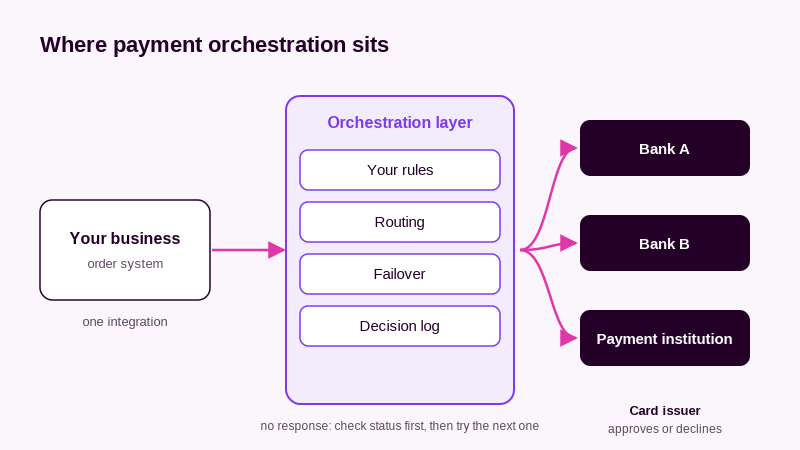
Payment orchestration in Turkey is the layer that puts several banks' virtual POS services and payment institutions behind one integration. "Virtual POS" is the Turkish name for a bank's e-commerce card acceptance service, and you sign for it with each bank. You send the payment to the layer; your rules and its routing decide which bank processes it. If a bank cannot be reached, the payment moves to the next one; if the request reached the bank but no answer came back, the result is queried first. When you compare payment orchestration platforms for Turkey, the real question is not which one connects the most banks. It is what the platform does in an outage, on an uncertain result and at month-end reconciliation. This guide defines the concept, then gives you questions to ask and a scoring example.
What is payment orchestration and what does it solve?
A card payment involves five parties: the cardholder, your business, your acquiring bank, the card scheme and the issuing bank. With one bank there is no choice in that chain. Connect a second and every payment raises a question: which bank should this one go through?
The orchestration layer answers it with rules you set. Your order system only says "collect this amount"; the card's issuer, the instalment count, the amount and each bank's current state are weighed in the layer. Instalments matter in Turkey: shoppers commonly split card purchases into monthly payments, and banks do not all offer the same plans on the same cards. We compared gateways and orchestration in detail in payment gateway vs payment operating system; here we focus on choosing.
As online card payments grow, so does the cost of depending on a single bank. According to the Interbank Card Center (BKM), online card payments in July 2026 rose 34 percent year on year to 908.9 billion TRY (Turkish lira), 30 percent of card payment value, across 258.7 million transactions (BKM, July 2026 press release). At that volume, a twenty-five-minute outage at one bank is no minor glitch.
Bank virtual POS, payment institution, orchestration: what is the difference?
These three are often confused in Turkey. None replaces the others, and most merchants use at least two.
| Criterion | Bank virtual POS | Payment institution | Orchestration platform |
|---|---|---|---|
| What it provides | Card acceptance (acceptance of payment instruments, listed in Law No. 6493, Article 12) under a direct agreement with the bank | Card acceptance, usually with collections passing through its own account | Managing several banks and payment institutions through one integration |
| Who provides it | The bank | A payment institution licensed by TCMB (Law No. 6493, Article 14) | A management layer with banks and payment institutions behind it |
| Fee agreement | Between you and the bank | Between you and the institution | Set up correctly, your own agreements stay in place |
| If the bank does not answer | Outcome unknown; you have to query it yourself | Depends on the provider | Moves to the next provider per your rules if the request never reached the bank; if it did, queries the result first |
| Integrations | One per bank | One per institution | One |
TCMB is the Central Bank of the Republic of Türkiye. It states that since 1 January 2020 it has been the competent authority for payment services and electronic money, and that payment service providers are banks, payment institutions, electronic money institutions and PTT, the postal operator (TCMB, Overview of payment services).
So ask any orchestration provider first: whose account does the collected money pass through? If it comes straight from your bank to you, orchestration is only a routing and management layer. If it passes through the provider's account, search for the provider's name in TCMB's list of payment institutions (TCMB, list of payment institutions). Whether a given set-up needs a licence is a legal assessment this post does not make; the wider framework is in our TCMB regulation guide.
When do you need orchestration?
Not everyone does. With a few hundred orders a month and a bank that goes down once or twice a year, a second virtual POS kept on standby by hand may be enough. The basics, and one bank versus several, are in what is a virtual POS.
If two of these apply to you, it is time to look seriously:
- you have agreements with at least two banks and do not know which gets better results on which cards;
- your main bank slows down on campaign days;
- you sell in instalments and banks do not all offer the same instalments on every card;
- your developers are tired of building a new integration for each bank;
- you match bank statements to orders by hand at month end.
Decide with a number. The figures below are illustrative, not a real merchant's data. At peak you take 240 orders an hour with a 900 TRY average basket. If your main bank is silent for 25 minutes, 100 orders are attempted in that window: 100 × 900 = 90,000 TRY at risk. That is the amount at risk, not what orchestration recovers. Failover only helps payments that have not yet entered 3D Secure, and some customers come back later anyway. Estimate the recoverable share from your own data, multiply it by how often this happens a year and compare the result with the platform's annual cost.
10 questions to ask when choosing a payment orchestration platform
Every sales deck promises "smart routing" and "high approval rates". The difference shows in the answers below. Get them in writing and test what you can in the sandbox.
1. Which banks and payment institutions are connected?
A list can look long on paper. The real question: are the banks you work with today on it, with instalments, 3D Secure, cancellations and refunds supported end to end for each?
2. Who keeps my bank agreements?
Orchestration should preserve your own fee agreements. Fee and settlement terms stay between you and the bank, and changing platform should not force you to renegotiate.
3. Up to which step does failover work?
The honest answer is usually "before 3D Secure authentication". 3DS authentication is tied to the transaction at the bank where it started; once the customer completes it, the payment cannot be quietly moved to another bank. If a provider claims failover at every stage, ask how. We cover the 3D Secure flow in our post on frictionless and challenge flows.
4. What happens when the bank does not answer?
A timeout is not a decline: the bank may have taken the money while its answer got lost on the way back. A platform that sends the payment to another bank without asking risks charging the customer twice. The right move is to ask the same bank for the result first. The full picture is in idempotency and double payments.
5. Which declines are retried?
Visa's rule is clear: it sorts decline codes into four categories; in the first (such as lost, stolen or closed cards) it prohibits retrying the same card, and in the others it allows at most 20 attempts in 30 days (Visa Core Rules, 24 October 2026). A decline such as insufficient funds gives the same result at another bank too. Ask to see the platform's decline code mapping; smart routing and approval rates shows how decline types affect routing.
6. Who controls the rules?
Can you read and edit routing rules yourself, or must you ask the provider? Can a rule be tested on past traffic before going live? When you want one card family to go to one bank for a campaign, you should not need a support ticket.
7. What does the AI decide, and what doesn't it?
Ask any provider selling "AI routing" three things: what does the model optimise (approval alone, or approval together with cost), how does a new model reach live traffic, and can you see the reasoning behind a decision? The issuing bank always decides whether to approve the payment; the model only picks which bank to try.
8. Where does card data pass?
The PCI Security Standards Council says PCI DSS applies to every entity that stores, processes or transmits cardholder data (PCI SSC, PCI DSS). The current version, v4.0.1, was published on 11 June 2024 (PCI SSC, v4.0.1 announcement). Whose page takes the card number, and whose systems store it? Your scope of responsibility depends on the answer.
9. Can you see each payment's history in one record?
If the first bank cannot be reached and a payment is approved at the second, your customer service team should see that on one screen. Refunds go through the bank that processed the payment, so this record is essential. We describe the structure in payment intent architecture.
10. What happens if the platform itself goes down?
A layer you put in front of your banks is a new dependency. The provider should explain in writing what happens during its own outage, where it publishes its status page and how it shares post-incident reports.
How do you score the answers?
Once you have filled in the ten questions for two or three candidates, you have a long pile of notes. Weighted scoring turns them into a decision: weight each question for your business, score each candidate from 1 to 5, multiply by the weight and add up. When you fill in the price row, check how the platform charges: a per-transaction fee, a flat subscription or a mix gives very different results at your volume.
This table is illustrative. The weights suit an e-commerce merchant where most sales are in instalments; A and B are not real companies.
| Criterion | Weight | Platform A | Platform B |
|---|---|---|---|
| Support for your current banks and instalment options | 3 | 5 (15) | 4 (12) |
| Querying first on an uncertain result | 3 | 5 (15) | 2 (6) |
| Retries by decline code | 2 | 4 (8) | 3 (6) |
| Managing rules yourself | 2 | 4 (8) | 5 (10) |
| Card data and PCI scope | 2 | 4 (8) | 4 (8) |
| One record per payment and reconciliation | 2 | 3 (6) | 4 (8) |
| Price | 1 | 3 (3) | 5 (5) |
| Total | 63 | 55 |
B looks cheaper and more flexible on rules, yet it falls behind because it does not query first on an uncertain result. That single row gives A a 9-point edge while the total gap is 8 points; without it, B would lead 49 to 48. This gap comes back to you as double charges, customer complaints and refund costs. Adjust the weights to your business: a low-margin, high-volume merchant may put more weight on price.
What should you test in the sandbox?
Decide on the trial, not the pitch. Before choosing a platform, run these five scenarios in its sandbox yourself:
- Standard, instalment and 3D Secure payments. For each, check the success and decline responses, the notification you receive and the dashboard record.
- A provider outage. Disable a bank and see whether payments move to the next.
- A timeout. Simulate a bank that never answers. Is the payment marked failed, or queried first?
- A duplicate request. Send two requests with the same idempotency key; the second should return the first result without reaching the bank.
- Refunds and cancellations. When the second bank processed a payment, confirm the refund also goes through that bank.
Also check that notifications arrive signed and carry an event ID you can use to filter out duplicates. In Lunixi they arrive as webhooks, and integration starts on the developers page.
How does Lunixi answer these questions?
Here are our own answers to the same questions. The decision is yours, and the criteria are above.
In Lunixi you connect banks' virtual POS services and payment institutions with your own accounts, so your fee agreements stay between you and the bank. 16 banks and payment institutions offering virtual POS in Turkey are connected, listed on the integrations page. Each payment goes to the provider chosen by current provider health, cost and the card's issuing bank; that choice is made in the banks and automatic failover infrastructure.
Failover happens before the 3D Secure step. When the provider cannot be reached or returns a provider-unavailable error, the payment moves to the next eligible provider; declines such as insufficient funds, an invalid card or failed 3D Secure are not tried at another bank. If the request reached the bank but no answer came back, the payment is not marked failed: the same provider is asked for the result first, and the final result is sent by webhook. The dynamic failover page walks through the outage scenario step by step.
Your policy lives in routing rules that you can read and edit, and rules are tested in simulation before going live. Beside the balanced, cost first and approval first strategies sit two learning models: Autonomous AI, which explores cautiously, and Adaptive AI, which experiments more widely. Both weigh approval probability against fees and the cost of held funds, produce decisions in shadow mode first, then go live on the traffic share you set. If you want fraud decisions on the same platform as payments, the Fraud and Risk product links to the same payment record.
See orchestration with your own banks in a demo
Frequently asked questions
Does payment orchestration replace my bank agreements?
No. An orchestration platform brings your agreements with banks and payment institutions behind one integration. Fee, settlement and holdback terms stay between you and the bank. If you switch platform, you usually don't need to sign new bank contracts; you just enter your connection details on the new platform.
Is payment orchestration the same as a payment institution?
No, they are not the same. A payment institution provides payment services under a TCMB licence, and collections usually pass through its account. Orchestration is the layer that manages several banks and payment institutions, and both can sit behind one orchestration platform. Ask each provider separately whose account the money passes through.
How many banks do I need to connect?
At least two; one connection leaves no second path to route to. Two banks give you a backup against outages. A third adds the option of routing the payment through the card-issuing bank's own virtual POS, and of comparing cost. Each new bank means another contract and another reconciliation, so add them as your volume grows.
Will orchestration lower my fees?
Not by itself. Cost-based routing can send the same payment through a bank with a lower fee, but your bank agreements set the outcome. A rule can exclude a high-fee bank from certain payments. To measure the saving, work out a one-month baseline cost before you switch.
How do you plan the move to orchestration?
How long it takes depends on how many banks you connect and how much of your payment, refund and notification flows you rewrite. The order: first write down your current routing rules, then build the integration end to end in the sandbox, open it to a small share of traffic, compare the results with bank statements, and only then increase the share. Keep the old integration running for a while so you have a way back.
Sources
- BKM, July 2026 press release (Turkish)
- TCMB, Overview of payment services (Turkish)
- TCMB, List of payment institutions (Turkish)
- Law No. 6493 on Payment and Securities Settlement Systems, Payment Services and Electronic Money Institutions (Turkish; Articles 12 and 14)
- Visa, Visa Core Rules and Visa Product and Service Rules (24 October 2026; section 7.3.6.3)
- PCI Security Standards Council, PCI DSS and PCI DSS v4.0.1 announcement
Accessed: 24 November 2026. Regulation, card scheme rules and provider coverage change; check each source's current version before you decide.