

What is a virtual POS? Turkey's "sanal POS" explained
Founder, Lunixi
A virtual POS is the software a bank gives a merchant to accept card payments on a website or in an app, without a physical card reader. In Turkey, where it is called sanal POS, it is the product banks sell for taking cards online: the payment gateway and the acquiring contract in one. English-speaking markets have no single name for that bundle. The closest-sounding term, virtual terminal, means something narrower: a page where the merchant's staff key in card details for phone and mail orders.
What does "virtual POS" mean?
It depends on where you ask.
| Term | Where it is used | What it means |
|---|---|---|
| Virtual terminal | UK, US | A web page where staff key in a customer's card details, typically for phone or mail orders |
| Payment gateway | UK, US | The technical service that sends the card details a customer enters at an online checkout for authorisation |
| Merchant account / acquiring | UK, EU | The contract with an acquirer that lets a business accept cards and receive the funds |
| Virtual POS (sanal POS, TPV virtual) | Turkey, Spain | A bank product for online card acceptance: gateway and acquiring contract in one |
The split between the first two rows is the one that causes confusion. The difference is who types the card number. With a virtual terminal, a member of the merchant's staff enters the details a customer reads out over the phone or sends in a mail order. With a gateway, the customer enters their own details at checkout, usually with 3-D Secure authentication along the way.
Regulators describe the underlying service, acquiring, in similar terms. EU law defines it as a payment service in which a provider contracts with a payee to accept and process payment transactions, so that the funds reach the payee (Directive (EU) 2015/2366, Article 4(44)). The UK's Payment Systems Regulator notes that a business that wants to accept cards has to buy card-acquiring services (PSR market review).
In Turkey, banks sell that service for the web under the name sanal POS. Akbank describes it as a software infrastructure for collecting card payments online, a piece of code integrated into the site and not a device (Akbank, in Turkish). Spain uses the same idea under the name TPV virtual: Redsys describes its TPV Virtual as a gateway contracted through a bank (Redsys, in Spanish).
According to Turkey's Interbank Card Center (BKM), online card payments reached TRY 923.9 billion in August 2026, 30 percent of all card payments that month (BKM press bulletin, August 2026, in Turkish).
How does a virtual POS work?
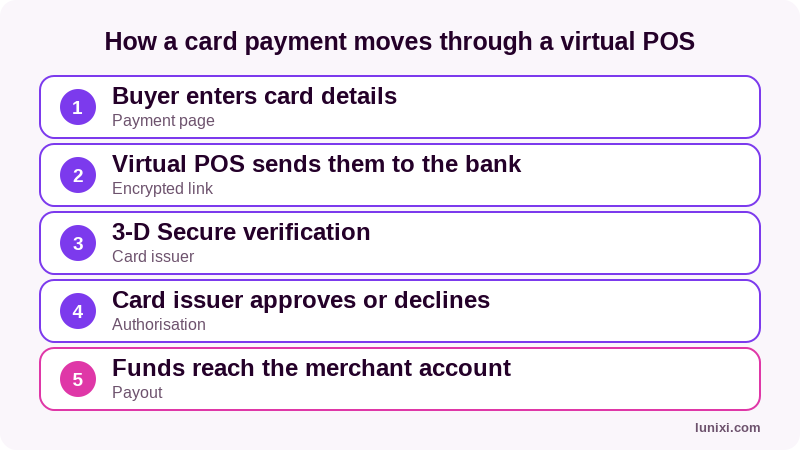
Turkish banks describe the sequence in the same way (Akbank blog, 12 June 2026; DenizBank, both in Turkish):
- The buyer enters card details on the payment page.
- The virtual POS sends them to the bank over an encrypted connection.
- If the merchant uses 3-D Secure, the card issuer verifies the cardholder, usually with a one-time code.
- The card issuer approves or declines the payment, and the answer comes back through the merchant's bank.
- Approved funds are paid into the merchant's account.
How does a merchant get a virtual POS in Turkey?
The merchant applies to a bank, or uses a licensed payment institution instead. The steps below come from the banks' own pages, which are in Turkish.
- Prepare the website. The bank reviews it. Garanti BBVA states that an application is turned down if the site has no products on sale (Garanti BBVA).
- Collect the documents. For a limited or joint-stock company: tax certificate (vergi levhası), trade registry gazette (ticaret sicil gazetesi) and signature circular (imza sirküleri). Sole proprietors provide ID, tax certificate and signature circular (Garanti BBVA).
- Apply. Akbank takes the application in its mobile app; İş Bankası's page sends applicants to a branch (Akbank; İş Bankası).
- Connect the site. Once the bank approves, the merchant connects the virtual POS to the shop, through an e-commerce platform's payment settings or the bank's own integration method.
What the banks look for on the site is largely the same: an SSL certificate, distance-selling and refund terms, visible contact details, and products with prices (İş Bankası; Akbank). İş Bankası and Garanti BBVA offer their own hosted payment page to merchants without SSL.
On cost, most of the bank pages we read publish no commission rate; the bank quotes a rate during the application. The only fixed fee we found published was on İş Bankası's page, which on 23 November 2026 listed an annual fee of TRY 13,999 including banking transaction tax (BSMV) (İş Bankası).
The alternative to a bank contract is a payment institution or an electronic money institution. These are authorised and supervised by the Central Bank of the Republic of Türkiye (CBRT, in Turkish TCMB), which has held that role since 1 January 2020 and publishes the list of licensed payment institutions (TCMB overview, in Turkish). What the regulator expects of them is the subject of our CBRT compliance playbook.
The document lists above are written for businesses registered in Turkey; none of the bank pages we read describes a route for a company registered abroad. This article does not cover company-formation or licensing requirements, which need local advice.
What is different about card payments in Turkey?
Instalments. A Garanti BBVA report based on BKM data puts instalment purchases at 19.5 percent of all credit card purchases in Turkey in 2025 (BBVA, 20 January 2026). Whether a given payment can be split depends on the card issuer and the merchant (TROY FAQ). Ask each bank which cards its virtual POS can offer instalments on.
TROY. Alongside Visa and Mastercard, Turkey has a domestic scheme. TROY was established in 2016 within BKM, and its cards are accepted at ATMs, POS terminals and online across the country (TROY).
3-D Secure. EMV 3-D Secure is the protocol issuers and merchants use to help prevent card-not-present fraud; riskier payments get a challenge such as a one-time passcode (EMVCo). European readers will recognise the step from strong customer authentication under PSD2 (Directive (EU) 2015/2366, Article 97). It matters to the merchant too: İş Bankası writes that where a merchant does not use 3-D Secure and the cardholder disputes the payment, the amount can be taken back from the merchant (İş Bankası). We cover the mechanics in 3DS 2.2: frictionless, challenge, and the engineering in between.
One bank or several?
One virtual POS is simple: one contract, one integration, one dashboard. The trade-off is that when that bank does not respond, you cannot take card payments.
Connecting several banks changes two things:
- Uptime. If one bank is down, the payment can go through another.
- Fees. Commission can differ from bank to bank, so you can choose where to send a payment.
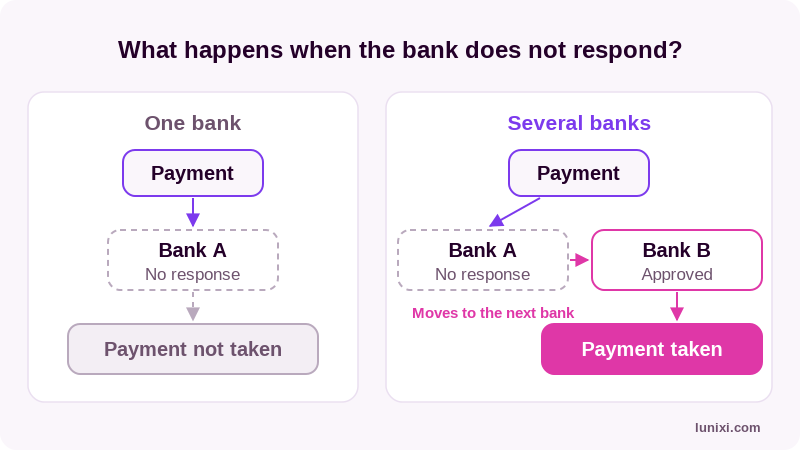
In return the workload grows: a separate integration, dashboard and reconciliation for each bank, plus a decision about where each payment should go. We look at how that decision affects conversion in how smart routing increases conversion rates.
Lunixi's Virtual POS Gateway puts those Turkish bank contracts behind one integration. You connect your own virtual POS accounts and payment institutions; each payment goes to the provider chosen for its current availability, its cost and the card's bank. On retryable errors such as an outage or a timeout, the payment moves to the next provider. Declines from the card issuer, such as insufficient funds, are not retried at another bank. The outage scenario is described under dynamic failover.
See multi-bank routing in a demo
Frequently asked questions
Is a virtual POS the same as a virtual terminal?
Not in Turkey. A virtual terminal is a page where the merchant's staff type in card details taken over the phone. A Turkish virtual POS is the bank's online acceptance product: the buyer enters their own card details at checkout.
Is a virtual POS the same as a payment gateway?
It includes one. A payment gateway is the technical connection. A Turkish virtual POS also comes with the bank's acquiring contract, so the bank that processes the payment is the one that pays the merchant.
Can a merchant have more than one virtual POS?
Yes. Each bank needs its own contract and integration. They can be connected one by one or placed behind a single routing layer.
Where is the card data entered?
That depends on the checkout. With a payment page hosted by the bank or the payment provider, the card number is typed into a form served by that provider. PCI DSS, the industry's baseline for protecting payment account data, applies to anyone who stores, processes or transmits cardholder data (PCI Security Standards Council). Our checkout and 3-D Secure page shows the hosted option.
Sources
- European Union, Directive (EU) 2015/2366 (PSD2)
- Payment Systems Regulator, Market review into card-acquiring services
- EMVCo, EMV 3-D Secure
- PCI Security Standards Council, PCI DSS
- Redsys, Pagos online (Spanish)
- BKM, August 2026 press bulletin (Turkish)
- TROY, About TROY and FAQ
- BBVA, Garanti BBVA report on card payments in Türkiye (20 January 2026)
- Central Bank of the Republic of Türkiye, payment services overview and payment institutions (Turkish)
- Akbank, Sanal POS and blog; Garanti BBVA, Sanal POS; İş Bankası, Sanal POS; DenizBank, Sanal POS (Turkish)
Bank pages were accessed on 23 November 2026. Requirements and fees change; check the bank's current page before applying.