

Online payment fraud: types, warning signs and prevention
Founder, Lunixi
Online payment fraud is any payment on your site that the real cardholder or account owner did not make, or any refund or dispute that the real owner has no right to. For a merchant the loss usually arrives weeks later as a chargeback: the goods have shipped, the money has been pulled back and a dispute fee sits on top. This guide covers the main types of online payment fraud merchants face, the trace each one leaves at the moment of payment, and how rules, risk scores and manual review work together. The goal is not only to stop fraudsters. It is to do that without turning away the customers who were always going to pay.
Why does online payment fraud concentrate on card-not-present payments?
In a shop, the chip and PIN prove that someone holds the physical card. Online, the card number, expiry date and security code are often enough. Those details come from phishing pages, compromised checkout pages and bulk data breaches, and they are traded on.
The UK numbers make the point. UK Finance reports that card fraud losses in 2025 were £594.9 million. Remote purchase (card-not-present) fraud accounted for £423.5 million of that, around 71 percent, and rose 3 percent on the year. Cases rose 13 percent to almost 3.2 million. The average remote purchase case has fallen from £300 in 2016 to £132, which suggests fraudsters are running more, smaller attempts. The industry also prevented £1.33 billion of card fraud in the same year (UK Finance, Annual Fraud Report 2026).
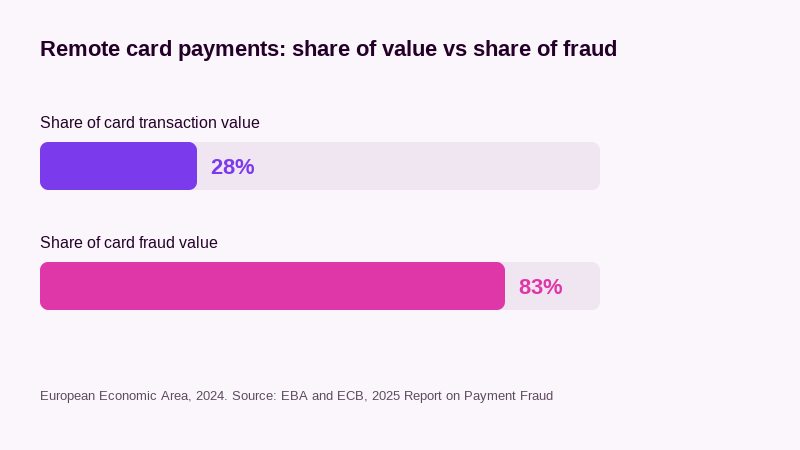
The European picture is similar. The joint EBA and ECB report found that around 83 percent of card fraud in the EEA in 2024, by value and by volume, was on remote payments, although remote payments were only about 28 percent of card transaction value and 18 percent of volume. The fraud rate for remote card payments was 0.091 percent by value, against 0.007 percent face to face (EBA and ECB, 2025 Report on Payment Fraud).
Law enforcement sees fraud growing too. Europol describes fraud schemes as the fastest-growing area of organised crime and lists fraud against payment systems among the most common online fraud types reported by member states (Europol, IOCTA 2026).
Which types of payment fraud will you see?
Six types cover most of the cases an online merchant deals with. The table sets the first warning sign and the first control side by side.
| Type | What happens | First sign | First control |
|---|---|---|---|
| Stolen card purchase | Someone orders with another person's card details | Card country differs from IP country, new device, express delivery | 3-D Secure on risky orders, address checks |
| Card testing | A bot tries a list of stolen cards with small amounts | Many declines in minutes, similar BIN range | Velocity limits, device fingerprinting, bot mitigation |
| Account takeover | A customer's account is taken over and the saved card used | Login from a new device, password and address change, then an order | Step-up at login, cooling-off after address change |
| Refund fraud | Goods arrive, the buyer claims they did not or the box was empty | Frequent refunds to the same address, high-value items | Proof of delivery, refund policy, customer history |
| First-party (friendly) fraud | The cardholder buys, then disputes the charge with their bank | A dispute from a customer with a clean history | Keep evidence, a recognisable billing descriptor, an easy refund route |
| Promotion abuse | One person opens many accounts to reuse a first-order discount | Many new accounts from one device or address | Device and address matching, conditions on the offer |
Stolen card purchases
This is the type everyone knows. The fraudster buys goods that resell easily: phones, headphones, game codes, gift cards. The signals are harmless on their own and telling together. An order placed at 1 a.m. from a device you have never seen, with a card issued in Spain, an IP address in the UK, a delivery address in a different city from the billing address and next-day delivery requested deserves a second look.
3-D Secure is the strongest single tool here. Visa says successful authentication reduces fraud risk and can shift liability away from the merchant, so an authenticated payment that is later disputed as "not me" largely becomes the issuer's problem (Visa, 3D Secure guide). In the UK and EEA, strong customer authentication is the default for remote card payments, with exemptions such as low value and transaction risk analysis (EBA and ECB, 2025 Report on Payment Fraud). EMVCo describes 3-D Secure as sharing transaction, payment method and device data with the issuer to help prevent card-not-present fraud (EMVCo, EMV 3-D Secure). Within the EEA in 2024, card payments without strong customer authentication had twice the fraud rate of those with it (EBA and ECB, 2025 Report on Payment Fraud). We explain the frictionless and challenge flows, and the exemptions, in our 3DS 2.2 guide.
Card testing
In card testing the aim is not to buy anything. It is to find out which cards work. A bot runs thousands of card numbers through your checkout or your "save card" endpoint, and the cards that are approved get used elsewhere for larger amounts. OWASP lists this as "carding" among automated threats to web applications, and calls the brute-forcing of missing expiry dates and security codes "card cracking" (OWASP, OAT-001 and OAT-010).
Visa, which calls the attack enumeration, says it causes more than a billion dollars of fraud losses every year and accounted for 8.7 percent of global fraud in 2025, with around 31 percent of attempts using zero-amount authorisations (Visa, What does enumeration mean in fraud?). The damage to you comes in two ways: approved test transactions return as disputes, and your decline rate rises in your acquirer's eyes.
During an attack, void or refund the small approved test transactions and put the endpoint behind a rate limit straight away. For lasting controls see our bot mitigation and device DNA use cases.
Account takeover
The fraudster takes a customer's email and password from another breach and tries them on your site. If the login works, the saved card, saved address and loyalty points are theirs. The usual sequence is a login from a new device, a change of delivery address or phone number within minutes, then a high-value order. To catch it you have to look at the whole session, not only the payment. Asking for 3-D Secure on a saved-card order from a new device is a real control here, because a stolen password does not pass the issuer's authentication. Our account takeover protection page walks through the flow.
Refund fraud and first-party fraud
In both, the card is in the real owner's hands, and the dispute is usually raised for a non-fraud reason such as item not received or not as described. The 3-D Secure liability shift does not cover those disputes. In refund fraud the buyer receives the goods and says they never arrived, or that the box was empty. In first-party fraud the cardholder made the purchase but tells their bank they did not. Sometimes there is no bad intent at all: they did not recognise the name on the statement, a family member placed the order, or a subscription renewed without them noticing.
Here the control is mostly evidence. Delivery records, IP and device data, the customer's earlier undisputed orders and your contact history are what you have when a dispute arrives. We cover the process in our chargeback glossary entry. A billing descriptor that matches the brand name customers know also stops a share of these disputes before they start.
Promotion abuse
Picture a skincare shop that gives 20 percent off the first order. One person opens ten accounts with ten email addresses and uses the discount ten times. The card is not stolen and the payment is approved, but your campaign budget is not reaching new customers. The shared trace is the device and the address: all ten accounts come from one phone and ship to one flat. Our promotion abuse protection page shows how to catch the match at sign-up.
Which signals matter at the moment of payment?
A fraud decision rarely rests on one data point. It comes from signals that confirm or contradict each other. These are the ones that do the most work:
- Velocity. How many attempts in the last hour or 24 hours from this card, device, IP address or email? This is the clearest trace of card testing.
- Country match. Do the card's issuing country (from the BIN), the IP country, the browser language and the delivery country line up?
- Device. Has this device been seen before, and with how many accounts or cards?
- Behaviour. Was the card number typed or pasted? Was the form filled in two seconds? This is often where bots and people differ.
- Account history. When was the account opened, when was it last changed, has it disputed before?
- 3-D Secure outcome. Was the payment authenticated, frictionless or challenged?
A worked example: an electronics retailer in Manchester sees 600 attempts on its save-card endpoint between 2:40 and 3:00 in the early hours of a Wednesday. Every amount is £0.50, 90 percent are declined, the card numbers come from a handful of BINs and the requests come from three device fingerprints. Blocking IP addresses alone does little here, because the bot rotates them. A device rule combined with a velocity rule shuts the attack down in the first minutes. (The figures are illustrative.)
How do rules, risk scores and manual review work together?
Fraud prevention works in three layers, and each covers a weakness of the others.
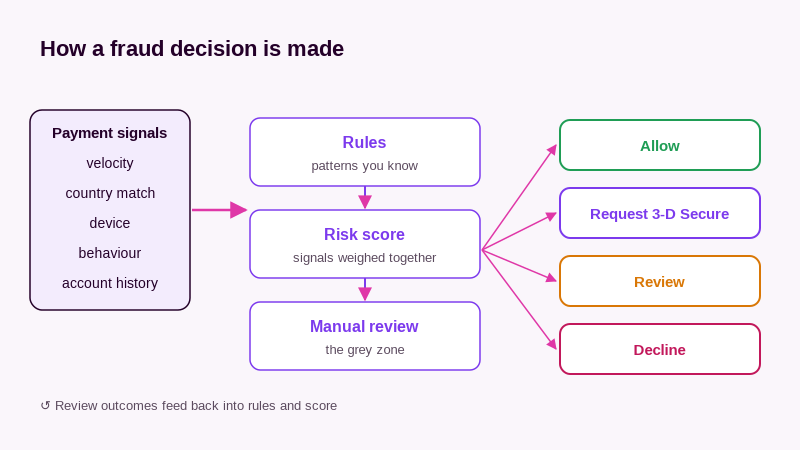
Rules are what you already know: "decline if one card has more than five attempts in an hour", "request 3-D Secure if the card country differs from the delivery country and the basket is over £500". Rules are transparent, auditable and quick to change. Their weakness is that they only catch the pattern you wrote down.
A risk score weighs many signals together and can spot patterns you never wrote a rule for. Its weakness is that it struggles to explain itself. Using the score as a threshold inside your rules, rather than as the decision on its own, reduces that problem: "review if the score is high and the account is new".
Manual review is for the grey zone. Nobody can look at every order, but five minutes on a first-time, high-value order costs far less than a chargeback. Review outcomes feed back into the rules and the score.
The layers end in one of four decisions: allow, request 3-D Secure, send to review, decline. Requesting 3-D Secure is often the best middle path: you usually save the order and hand the risk to the issuer's authentication. Some customers still drop out at the challenge, so measure that loss too. You can see the four decisions returned from one endpoint, with reasons, in Fraud and Risk.
What does a false decline cost you?
The hidden cost of fraud prevention is the genuine customer you stop. Take a hypothetical fashion store with 8,000 orders a month and an average basket of £60. Tight rules decline 3 percent of orders, 240 in total. Looking back, 40 were fraud and 200 were good customers.
| Item | Calculation | Amount |
|---|---|---|
| Fraud prevented (at sale value) | 40 × £60 | £2,400 |
| Good revenue lost | 200 × £60 | £12,000 |
| Gross profit lost (30 percent margin) | £12,000 × 0.30 | £3,600 |
The fair comparison is on profit: blocked fraud saves you at most the cost of the goods plus the dispute fee, while a false decline takes the margin. We have deliberately counted prevented fraud at full sale value, a generous upper bound. Even so, at a 30 percent margin the £3,600 of lost gross profit here exceeds the £2,400 of fraud prevented, and some of the declined customers never come back. Track two numbers together: your chargeback rate and the share of orders declined by your fraud rules. Asking for 3-D Secure instead of declining can win back some of those 200 customers. To separate bank-side declines and set up retries properly, see our article on smart routing and conversion.
How do you protect the payment page itself?
Some fraud starts on your own site. A malicious script injected into the checkout page can copy the card details a customer types and send them elsewhere. The PCI Security Standards Council highlights two requirements for this: scripts on payment pages must be authorised and their integrity assured (6.4.3), and unauthorised changes to the page must be detected (11.6.1). Both became mandatory after 31 March 2025 (PCI SSC, e-commerce requirements announcement).
Not taking card details on your own page at all, by serving the payment form in a secure iframe or a redirect, cuts this risk sharply. In our virtual POS guide we suggest asking every provider where card data travels.
How can a small team set up fraud prevention?
If you have no dedicated risk team, work through it in order:
- Measure. Split the last six months of chargebacks by type: stolen card, item not received, unrecognised transaction.
- Make 3-D Secure a rule. Ask for authentication on new customers, high amounts and country mismatches.
- Add velocity limits. Cap attempts per card, device and IP on the checkout and save-card endpoints.
- Send the grey zone to review. Queue as many orders as you can actually review each day and decide the rest automatically.
- Keep evidence. Hold delivery, IP, device and contact records for the whole dispute window.
- Recalibrate monthly. Read false declines and missed fraud together and move thresholds.
What does Lunixi do in these layers?
Lunixi Fraud and Risk is a fraud engine that decides in real time using your own rules. You send the transaction in one call; the engine runs the flow you published and returns allow, force_3d, review or block together with the flow, node and rule it came from. If a flow errors, the decision never passes silently; it rises to at least review.
For card payments, payment fraud covers 3-D Secure step-up decisions, card testing and merchant risk templates, behavioural signals such as paste count, tab switches and typing cadence, velocity rules and card country mismatch. You send a token or fingerprint, never the card number. You do not need the Lunixi payment stack: your own backend can call the same endpoint in front of your existing payment flow. You can set flows and thresholds together with our team.
Book a demo for your fraud flows
Frequently asked questions
Which type of online payment fraud costs merchants most?
In European data, stolen card details are the largest source of remote card fraud: in 2024 they accounted for more than 56 percent of its value (EBA and ECB). In the UK, remote purchase fraud is the biggest category of card fraud losses. To see your own mix, split your chargebacks by reason code.
Does 3-D Secure protect me from all fraud?
No. 3-D Secure moves most of the liability for authenticated payments disputed as fraud to the issuer. Disputes for item not received, not as described or subscriptions fall outside it, and that is where most refund fraud and much first-party fraud ends up. For account takeover, asking for 3-D Secure on saved-card orders from a new device is a real control. Use it together with rules and good evidence.
How do I know I am under a card testing attack?
The clearest sign is a burst of small declined transactions in a short time. Similar BIN ranges, many cards from one device and spikes at night are common too. Monitoring declines per minute with an alert threshold lets you spot an attack in its first minutes.
What should I do when a fraudulent order comes in?
If it has not shipped, cancel it and refund the payment; a refund costs less than a later chargeback. If it has shipped, ask the carrier to stop delivery. Either way, record the order's IP, device and address and check other orders with the same traces.
Do fraud rules lose me customers?
They can, if they are tuned badly. Every declined genuine order is lost revenue and often a lost customer. Requesting 3-D Secure instead of declining, and reviewing orders you are unsure about, reduces that loss. Measure false declines as regularly as chargebacks.
Sources
- EBA and ECB, 2025 Report on Payment Fraud (December 2025)
- UK Finance, Annual Fraud Report 2026 (June 2026, 2025 data)
- Visa, What does enumeration mean in fraud?
- OWASP, OAT-001 Carding and OAT-010 Card Cracking
- PCI Security Standards Council, New guidance coming for e-commerce security requirements in PCI DSS v4.x (6 November 2024)
- EMVCo, EMV 3-D Secure
- Visa, 3D Secure: your guide to safer transactions
- Europol, Internet Organised Crime Threat Assessment (IOCTA) 2026
Accessed 24 November 2026. This article is for information only. Regulation and card scheme rules change; confirm your obligations with your acquirer.