

How remote identity verification works: NFC chip and liveness
Founder, Lunixi
Remote identity verification is how a customer proves who they are without walking into a branch, and in practice it comes down to four checks: reading the identity document, verifying the document's chip over NFC, testing that the face in front of the camera belongs to a real, live person, and comparing that face with the photo on the document. Each check answers a different question. The chip shows the document was issued by a state and its data has not been altered. The liveness check shows there is a human in front of the camera rather than a photo or a screen. Face matching shows that this human is the document holder.
This guide walks through how each step works technically, which standard it rests on and, just as important, what it does not prove. We also look at how one regulator wrote chip checks into its rules, what to do when the customer's phone has no NFC, and how to pick layers by risk. It describes technical and regulatory texts; it is not legal advice.
What are the steps of remote identity verification?
Picture the sign-up flow of a digital wallet, an investment app or an e-money institution. The customer downloads the app, photographs both sides of their ID card or the data page of their passport, holds it against the back of the phone, then records a short selfie video. They see four screens. Behind them, this runs:
- Document capture and reading. The document type, the visual zone fields and the MRZ are read from the image.
- NFC chip reading. A key derived from the MRZ opens the chip; identity data and the face image are read and the signature is verified.
- Liveness check. The system tests whether the face on camera belongs to a real person who is present right now.
- Face matching. The face from the liveness session is compared with the chip photo (or the printed photo).
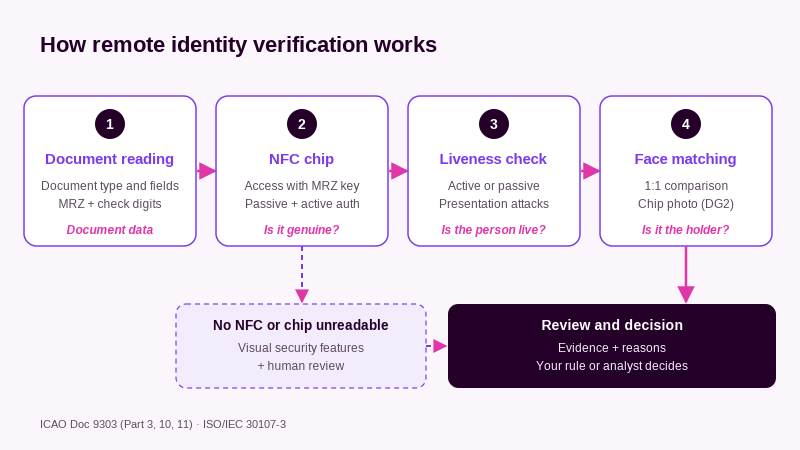
The order is not arbitrary. The chip is unlocked with information printed on the document, and the chip photo is the best reference for face matching. So document reading comes first and face matching comes last. Lunixi's KYC and onboarding product runs these four steps as one flow and adds KYB and beneficial ownership checks for business customers.
What is the MRZ and why is document reading the first step?
Passports and chip ID cards carry lines of text in a fixed typeface, padded with < characters. This is the machine readable zone, and its format is defined in the International Civil Aviation Organization's Doc 9303 (ICAO Doc 9303, Part 3). ID-card-sized documents (TD1) have three lines of 30 characters; passports (TD3) have two lines of 44.
One useful property of the MRZ is its check digits. The document number, date of birth and date of expiry each get one: multiply the digits by the repeating weights 7, 3 and 1, add them up, and the remainder after dividing by 10 is the check digit. Someone born on 1 January 1990 has "900101" in the MRZ. The sum is 9×7 + 0×3 + 0×1 + 1×7 + 0×3 + 1×1 = 71, so the check digit is 1. If a character is misread from the image, the check digit fails and the app can ask the customer to retake the photo. That small check catches one of the most common read errors, confusing "0" and "O" in poor light, before anything reaches the server.
The second reason matters more: the chip access key is derived from the MRZ. With Basic Access Control (BAC) the key comes from the document number, date of birth and date of expiry; the newer PACE protocol can also use the card access number (CAN) printed on the card (ICAO Doc 9303, Part 11). No correct MRZ, no chip. This also makes it harder for someone who is not holding the document to read the chip from a distance.
How the reading model behaves matters too. Lunixi's document reading model does not guess a field it is unsure of; it leaves it empty, sends unclear documents to review, and treats chip data as authoritative once the chip has been read. A reader that guesses can confidently write the wrong date of birth, and then the chip simply will not open.
What does NFC chip verification prove?
On a chip document, data sits in "data groups" (ICAO Doc 9303, Part 10). DG1 holds the same information as the MRZ, DG2 the face image. A file called the Document Security Object (SOD) holds a hash of each data group and the issuing state's signature over those hashes. Chip verification is two different checks, and they are easy to mix up.
Passive authentication: has the data been changed?
In passive authentication the reader verifies the SOD signature with the Document Signer certificate, and that certificate against the issuing country's root certificate (CSCA). It then recomputes the hash of every data group read from the chip and compares it with the SOD. If the hashes match, the data is what the issuing authority wrote. Root certificates are exchanged bilaterally between states or through ICAO's Public Key Directory (PKD).
What passive authentication does not prove: that the chip is not a clone. If someone copies every file from a genuine chip onto a blank one, the signature still checks out, because the signature protects the data, not the chip.
Active authentication and chip authentication: is the chip a copy?
For clone detection the chip holds a private key that cannot be read out. In active authentication the reader sends a random challenge, the chip signs it with its private key, and the reader verifies the signature with the public key in DG15. Chip Authentication reaches the same goal through a key agreement. A cloned chip can carry the public key but not the private key, so it fails the challenge (ICAO Doc 9303, Part 11).
Some regulators write this distinction straight into their rules. Turkey's banking regulation on remote identification requires that NFC verification check both that the document was issued by the competent authority with unaltered chip data, and that the chip keys were not created by copying (BDDK regulation, Official Gazette, 1 April 2021, Article 7). The first part maps to passive authentication, the second to clone detection. Lunixi's NFC chip reading passively authenticates e-passport and ID card chips over NFC; which checks are mandatory in your flow depends on the rules you operate under.
What happens when the phone has no NFC?
Not every customer has an NFC phone, and on some phones that do, the card is never read because the customer cannot find the antenna. Your flow has to plan for this from day one. The same Turkish regulation says that if chip verification cannot be done for any reason, at least four visual security features of the document must be verified for form and content, with extra conditions for the bank (BDDK regulation, Article 7(3)). Depending on the document, visual features include holograms, optically variable ink, microprinting or the security pattern over the photo.
In practice the cost of the fallback lands on your operations team. Suppose an app takes 10,000 applications a month, 8% of them go down the no-NFC path, and each takes an analyst 4 minutes. That is 800 × 4 = 3,200 minutes, roughly 53 hours of review a month. Getting the rate down to 3% cuts that to 20 hours. And the fix is usually design rather than technology: an animation showing where to hold the card, haptic feedback so the customer keeps the card still during the read, and a second attempt for anyone who fails the first.
How does a liveness check work?
The liveness check answers one question: does the face in front of the camera belong to a real person who is actually there? The attack it defends against is called a presentation attack: a printed photo, a video played on a phone or tablet, a paper or silicone mask. Test and reporting methods for presentation attack detection (PAD) are defined in ISO/IEC 30107-3. The standard works with two error rates: how often an attack is accepted as a real person (APCER) and how often a real person is rejected as an attack (BPCER).
There are two approaches:
- Active liveness asks the customer to do something: turn their head, blink, follow a dot on the screen. When the prompt is random, a pre-recorded video becomes much harder to use.
- Passive liveness asks for nothing and looks at signals in a short capture: texture, depth cues, reflections and consistency between frames. It is quicker for the customer.
The two can be combined. Lunixi's liveness detection model evaluates each frame separately, works against presentation attacks such as photos, screens and masks, and does not return pass or fail; it returns evidence and reasons, and your rule or your analyst makes the decision.
One limit is worth knowing. ISO/IEC 30107-3 covers attacks presented to the capture device, the camera. If an attacker bypasses the camera and injects fake video straight into the app's data stream, that is not a presentation attack and falls outside the standard's scope. Many deepfake attempts arrive this way. So liveness results should be read together with device integrity, virtual camera detection and session signals; several of the signals described in our guide to online payment fraud apply to fake sign-ups as well.
What does face matching compare?
Face matching is 1:1 verification: it estimates how likely it is that two face images belong to the same person. That is different from 1:N identification, which searches a database to find out who someone is. In remote verification the two images are the face from the liveness session and the photo of the document holder.
Where the reference photo comes from changes the result. The printed photo on the card is small, sits under a hologram, glares in the capture and may have been swapped on a forged document. The DG2 chip photo, once it has passed passive authentication, is the image the state wrote. Lunixi's face matching model compares the selfie with the ID photo, can use the chip photo, and returns a similarity score with evidence rather than a yes or no.
Choosing the threshold is a risk decision. Raise it and false matches drop, but more genuine customers go to review; lower it and the opposite happens. Record the threshold you chose, the samples you tested and the result. In an audit the question will be "why this value?"
Which check proves what, and what does it not prove?
| Check | What it proves | What it does not prove |
|---|---|---|
| MRZ reading and check digits | The printed data was read consistently | That the document is genuine |
| Passive authentication (chip signature) | Chip data was written by the issuer and not altered | That the chip is not a clone |
| Active / chip authentication | The chip is genuine, not a clone | That the holder is the owner |
| Visual security features | The physical features of the document match | Evidence as strong as chip verification |
| Liveness check | A real person is in front of the camera | Who the person is; that the feed was not injected |
| Face matching | The live face resembles the document photo | That the document is genuine |
The table makes one point: no single check is enough. The chip proves the document, liveness proves the human, and face matching proves the link between the two.
Which layers should you use for your risk level?
Not every flow needs all four layers at the same strength. For a regulated firm, the applicable rules decide which methods a bank, payment institution or crypto-asset service provider may use. In the EU, the European Banking Authority's guidelines on remote customer onboarding describe the minimum checks and the management body's responsibility for these processes, and they have applied since 2 October 2023 (EBA/GL/2022/15). The Turkish banking regulation above also requires a real-time, uninterrupted video call with a trained customer representative.
Where the rules leave room, risk decides. Two examples:
An online shop wants to verify the buyer on high-value orders. Document reading, passive liveness and face matching are often a sensible first layer; NFC can be an extra step for suspicious orders.
A digital wallet opens accounts that customers will load with money. Here chip verification, liveness and face matching should run together, with a fallback and human review when NFC fails. The verified person must also be screened against sanctions lists, which we cover in our sanctions screening guide. In Turkey, payment and e-money institutions follow separate rules from the central bank's information systems communiqué (Art. 22) and MASAK Communiqué No. 19; our guide to Turkish payment regulation sets out that framework.
Whatever you choose, two rules always hold: keep the results and the evidence, and do not hold biometric data longer or less protected than you need to. At Lunixi, biometrics are encrypted with a customer-specific key and requests carrying more data than needed are rejected.
How do you add these steps to your app?
Building the flow from scratch means camera handling, MRZ reading, NFC protocols, country certificates and model updates. Most teams use an SDK. Lunixi's mobile KYC SDK for iOS and Android runs with a ready-made UI or headless, and includes NFC and liveness modules; there is a separate KYC SDK for the web. You can find them all on the integrations page.
For the first week, an app team should decide which document types to accept, write what the customer sees when NFC fails, set thresholds with a test set, and design which evidence the analyst sees on the review screen.
Frequently asked questions
Is NFC identity verification enough on its own?
No. Chip verification shows the document is genuine and unaltered, but not that the person holding it is its owner. A stolen genuine ID card passes the chip check. That is why chip verification is paired with a liveness check and face matching.
What is the difference between passive and active authentication?
Passive authentication checks that the chip data was signed by the issuing state and has not been changed. Active authentication runs a challenge with the private key inside the chip to show the chip has not been copied. The first protects the data, the second the chip.
Can a liveness check catch deepfake videos?
A deepfake shown on a screen held up to the camera is a presentation attack, and a good liveness check targets it. If the fake video bypasses the camera and is injected into the app, that is not an attack ISO/IEC 30107-3 covers, and you need extra controls such as device integrity and virtual camera detection.
Can you verify identity remotely without NFC?
Yes, by another route. Turkey's banking rules, for example, require at least four visual security features to be verified, plus extra conditions, when chip verification is not possible. Other sectors and countries follow their own rules.
Should face matching use the chip photo or the printed photo?
The chip photo, where possible. Once it has passed passive authentication it is the image the issuer wrote, without the glare, hologram and tampering risk of the printed one. If the chip cannot be read, the printed photo is used and the result is weighed accordingly.
Sources
- ICAO, Doc 9303 Machine Readable Travel Documents, Part 3: Specifications Common to all MRTDs (8th edition, 2021)
- ICAO, Doc 9303, Part 10: Logical Data Structure for Storage of Biometrics and Other Data in the Contactless IC (8th edition, 2021)
- ICAO, Doc 9303, Part 11: Security Mechanisms for MRTDs (8th edition, 2021)
- ICAO, Public Key Directory (PKD)
- ISO, ISO/IEC 30107-3:2023 Biometric presentation attack detection, Part 3: Testing and reporting
- EBA, Guidelines on the use of remote customer onboarding solutions (EBA/GL/2022/15) (22 November 2022)
- BDDK, Regulation on remote identification methods used by banks and establishing contractual relationships electronically (Official Gazette of Turkey, 1 April 2021, No. 31441; in Turkish, read with later amendments)
Accessed 28 November 2026. This article is for information only and is not legal advice. Remote identification rules differ by type of firm and change over time; check the official text in force before you implement.